Custom Foam Inserts: Pick-and-Pluck, CNC-Cut, Water-Jet, ESD
How to choose the right foam type for your protective case. Density, cell structure, and use case compared.
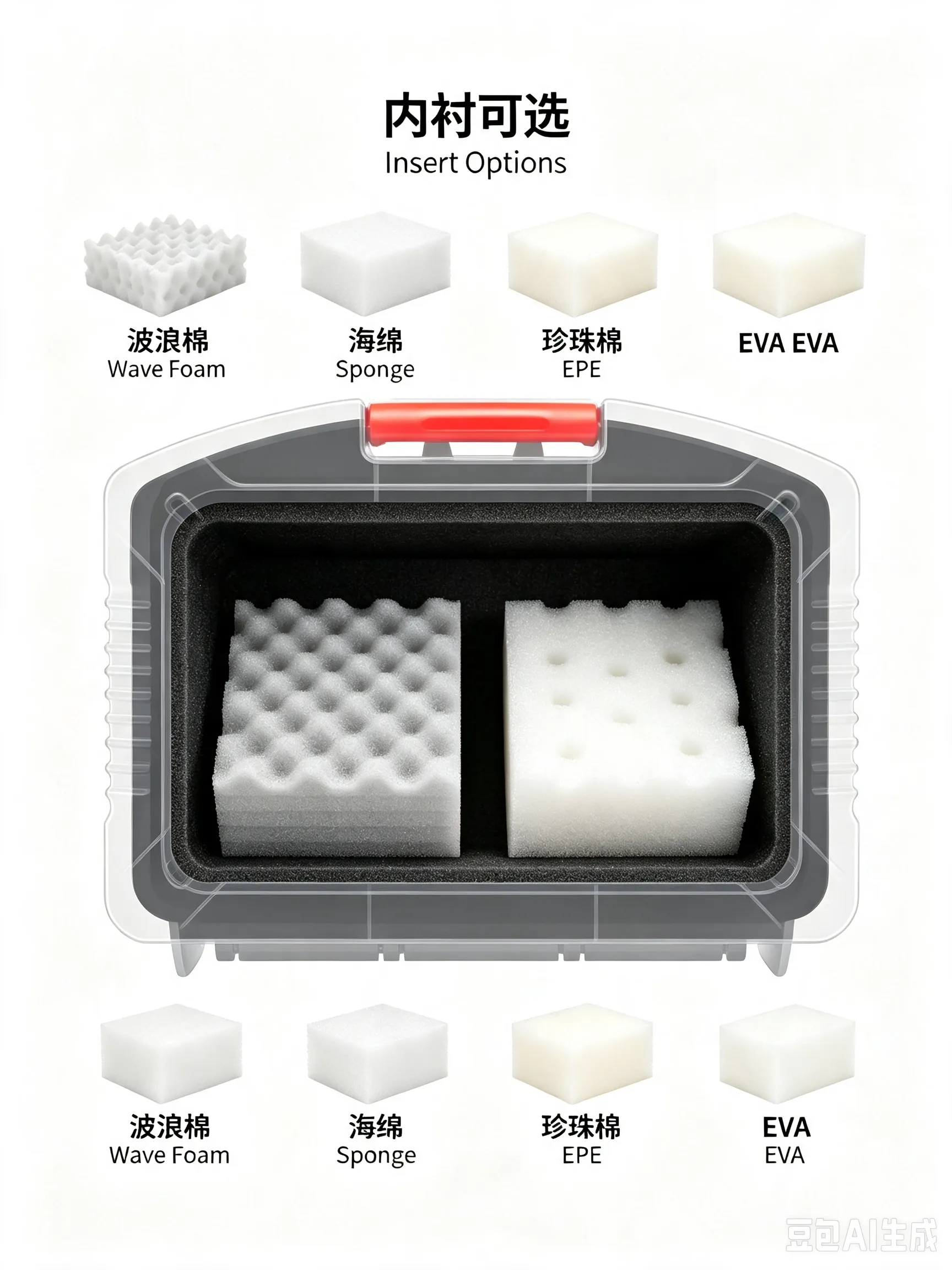
Direct answer: Custom foam inserts protect your product inside the case with shaped cavities matching the exact dimensions of your equipment. Kexin offers 4 foam types: PU (polyurethane) for general use, EVA for premium feel, EPE for cost-effective padding, and custom CNC-cut for complex shapes. MOQ 500 pieces for custom CNC; samples 7–10 days. Per-case foam cost USD 2–8 depending on type and density.
Why Custom Foam Inserts Matter
A protective case without a custom foam insert is just an empty box. The foam insert is what actually holds your product in place, absorbs shocks, and prevents damage during transport. For B2B customers shipping cameras, drones, medical instruments, or industrial tools, the foam insert is often more important than the case itself. A well-designed foam insert can reduce in-transit damage by 80–95%.
Custom foam inserts also improve the unboxing experience. When a customer opens a case and sees the product held firmly in a precisely cut cavity, it conveys quality. For brands selling to defense, medical, or industrial buyers, the foam insert is a key part of the product presentation.
4 Foam Types We Offer
| Type | Material | Density | Cost per case | Best for |
|---|---|---|---|---|
| PU (polyurethane) | Polyurethane foam | 18–35 kg/m³ | USD 2–5 | General use, light equipment |
| EVA (ethylene-vinyl acetate) | EVA foam | 30–80 kg/m³ | USD 4–8 | Premium feel, cameras, instruments |
| EPE (expanded polyethylene) | Polyethylene foam | 20–35 kg/m³ | USD 1.5–3 | Cost-effective, MRO, tools |
| Custom CNC-cut | Any of above + CNC routed | Per spec | USD 5–15 (one-time tooling) | Complex shapes, multi-cavity |
| Pick-and-pluck | Pre-scored PU/EPE | 25–30 kg/m³ | USD 2–4 | Variable content, prototyping |
| Anti-static | PU/EVA with carbon fiber | 30–50 kg/m³ | USD 4–10 | Electronics, ESD-sensitive |
For most B2B cases, EVA is the best balance of cost, durability, and feel. For cost-sensitive MRO or large industrial orders, EPE works well. For electronics and circuit boards, anti-static foam is required. For prototypes or variable content, pick-and-pluck is fastest (no tooling, hand-pluck to fit your product).
Foam Density and Compression
Foam density affects both protection and cost. Higher density = more protection but more expensive. The right density depends on the weight of your product:
| Product weight | Recommended density | Compression at 25% | Use case |
|---|---|---|---|
| 0–1 kg | 20–25 kg/m³ | 4–6 kPa | Small electronics, accessories |
| 1–5 kg | 25–30 kg/m³ | 5–8 kPa | Handheld instruments, tools |
| 5–15 kg | 30–45 kg/m³ | 7–12 kPa | Cameras, drones, medical devices |
| 15–30 kg | 40–60 kg/m³ | 10–18 kPa | Industrial equipment, instruments |
| 30+ kg | 50–80 kg/m³ | 15–30 kPa | Heavy equipment, server racks |
Higher density foam provides more impact absorption but adds cost. For most cases, 30 kg/m³ EVA is the sweet spot. Kexin engineering can recommend the right density based on your payload and use case.
Custom CNC Foam Cutting: How It Works
- 3D model or drawing. Send us your product's 3D model (STEP / IGES / STL) or 2D drawing with dimensions. We also accept physical samples for reverse-engineering.
- DFM review. Our engineering team reviews the model for foam manufacturability. We suggest draft angles, undercut solutions, and tolerance adjustments.
- 2D layout. We create a 2D DXF layout showing cavity shapes, depths, and parting lines.
- Sample cut (T1). We cut a T1 foam sample using a hot-wire CNC cutter. Lead time 7–10 days.
- Customer approval. You fit your product in the T1 sample. Adjust if needed.
- Tooling (if needed). For complex multi-cavity designs, we may need a custom cutting tool. Cost USD 200–1,000 one-time.
- Mass production. 30–45 days for 1,000+ foam sets. Cut on CNC, quality-checked, packed in cases.
Lead time for new custom foam: T1 sample 7–10 days, customer approval 5–7 days, tooling 10–15 days (if needed), mass production 30–45 days. Total 6–8 weeks for first OEM order.
Pick-and-Pluck Foam: Fast Prototyping
Pick-and-pluck foam is pre-scored PU or EPE foam with a grid of small cubes (typically 15×15 mm or 20×20 mm). You pluck out the cubes to fit your product. Benefits:
- No tooling. Lead time 3–5 days.
- Variable content. Same foam fits different products.
- Low MOQ. 50 pieces or 1 sample.
- Cost. USD 2–4 per case, no tooling cost.
Drawbacks: less precise fit, less premium feel, not suitable for shipping heavy or fragile items. For prototypes, field testing, or small batches, pick-and-pluck is ideal. For mass production, custom CNC-cut is more cost-effective.
Foam Colors and Branding
Standard foam colors are charcoal gray (PU) and black (EVA/EPE). Custom colors are available for orders of 500+ pieces:
| Color | MOQ | Cost premium | Lead time |
|---|---|---|---|
| Charcoal gray (standard PU) | 1 | Baseline | In stock |
| Black (EVA / EPE) | 1 | Baseline | In stock |
| Black (PU) | 500 | USD 0.5/case | 15 days |
| Custom color (any Pantone) | 1,000 | USD 1.5/case | 25–30 days |
| Anti-static (black with carbon) | 500 | USD 2/case | 20 days |
Foam can also be screen-printed with your logo (USD 0.3–0.8 per case, 1-color, MOQ 500) or laser-etched (USD 0.5–1.5 per case, MOQ 200). Both are common for OEM branding.
Foam Layers and Combinations
Most cases use 2–3 foam layers:
- Bottom layer (custom cavity). Holds the product, typically 30–60 mm thick depending on product size.
- Middle layer (optional). Spacer or accessory cavity (cables, batteries, manuals).
- Top layer (lid foam). Flat or convoluted (egg-crate) foam, 20–40 mm, presses the product down for snug fit.
Convoluted (egg-crate) foam on the lid is cost-effective and works for many products. For precision equipment, we recommend a custom flat lid foam with matching cavities. For multi-piece sets (e.g. camera + lens + battery + charger), we design a multi-cavity layout with each piece in its own slot.
Foam Specifications and Standards
| Standard | Test | What it covers |
|---|---|---|
| ISO 845 | Apparent density | Foam density measurement |
| ISO 3386 | Compression stress | Force to compress 25 / 40 / 60% |
| ISO 1856 | Compression set | Recovery after long-term compression |
| ISO 3795 | Burning behavior | Flame retardancy (FMVSS 302 equivalent) |
| UL 94 HF-1 | Flame rating | Horizontal burn test |
| REACH / RoHS | Chemical content | No hazardous substances |
All Kexin foams are REACH / RoHS compliant by default. For aviation or rail applications, UL 94 HF-1 or FMVSS 302 flame-rated foam is available. For ESD-sensitive electronics, anti-static foam (10⁶–10⁹ Ω) is standard.
How to Order Custom Foam
- Send 3D model or 2D drawing of your product. Or physical sample for reverse-engineering.
- Specify foam type (PU / EVA / EPE / pick-and-pluck / anti-static) and density.
- Specify layer count (bottom, middle, top) and lid style (flat / convoluted / custom).
- Specify color, logo print, and any special requirements (ESD, flame-retardant).
- Receive DFM feedback and 2D layout within 24–48 hours.
- Approve T1 sample (7–10 days).
- Mass production 30–45 days for 1,000+ sets.
Per-foam cost: USD 2–8 for standard types, USD 5–15 for CNC-cut complex. Tooling (if needed): USD 200–1,000 one-time. MOQ 500 pieces for custom.
FAQ
What's the difference between PU, EVA, and EPE foam?
PU (polyurethane) is soft, general-purpose, low cost. EVA (ethylene-vinyl acetate) is denser, more durable, premium feel. EPE (expanded polyethylene) is rigid, lightweight, cost-effective. PU for light items, EVA for premium/instruments, EPE for MRO/tools.
How long does custom foam cutting take?
T1 sample: 7–10 days. Customer approval: 5–7 days. Tooling (if needed): 10–15 days. Mass production: 30–45 days for 1,000+ sets. Total 6–8 weeks for first order.
Can you make foam from a physical sample (no drawing)?
Yes. We can 3D scan your physical sample and reverse-engineer the cavity. Cost: USD 200–500 one-time for scan + 3D model. Add 5–7 days to T1 sample lead time.
What's the minimum order for custom foam?
500 pieces for custom CNC-cut. 50 pieces for pick-and-pluck. 1 piece for samples (USD 100–300 per sample including case + foam).
Is anti-static foam necessary?
Required for ESD-sensitive electronics (circuit boards, hard drives, sensors). Surface resistivity 10⁶–10⁹ Ω. Adds USD 2–5 per case. Non-ESD foam can damage components.
Can you print our logo on the foam?
Yes. Screen print (1–2 color, USD 0.3–0.8/case, MOQ 500) or laser etch (USD 0.5–1.5/case, MOQ 200). Logo file: AI / PDF / SVG.
What's the difference between flat and convoluted lid foam?
Flat lid foam: smooth top, custom cut to match bottom cavity. Better aesthetics, holds product firmly. Convoluted (egg-crate): wavy surface, generic fit, cheaper. Use flat for premium / precision; convoluted for cost-sensitive / variable content.
How much does custom foam cost per case?
USD 2–5 for PU, USD 4–8 for EVA, USD 1.5–3 for EPE, USD 2–4 for pick-and-pluck, USD 4–10 for anti-static, USD 5–15 for CNC-cut complex. Tooling USD 200–1,000 one-time.
Do you offer flame-retardant foam?
Yes. UL 94 HF-1 or FMVSS 302 rated foam for aviation, rail, and military applications. Adds USD 1–3 per case. MOQ 500.
Can foam be replaced if it wears out?
Yes. We supply replacement foam sets for all our cases. Lead time 7–15 days. Cost is the same as the original. We can also redesign if your product changes.
What's the densest foam you offer?
80 kg/m³ EVA for heavy industrial equipment. We also offer 100+ kg/m³ specialty foams on request. Higher density = more cost, less cushioning but more support.
How do you prevent foam from absorbing water?
Standard PU/EVA foam absorbs 1–3% water by weight. For marine applications, we offer closed-cell foam (EPE, cross-linked PE) with <0.1% water absorption. Adds USD 1–3 per case.
Can the foam be removable for cleaning?
Yes. All our foam inserts are removable. We design with finger pull-tabs or no-adhesive backing for easy removal. For medical applications, foam can be sterilized at +121 °C in autoclave (medical-grade foam only).
For more on case design, see our OEM/ODM page or customer case studies. To order custom foam, fill out the 4-step RFQ form or email [email protected].