How Kexin Engineers Your Custom Protective Case
Behind the scenes of our 6-step OEM/ODM process: CAD design, DFM review, tooling, injection, foam, QC.
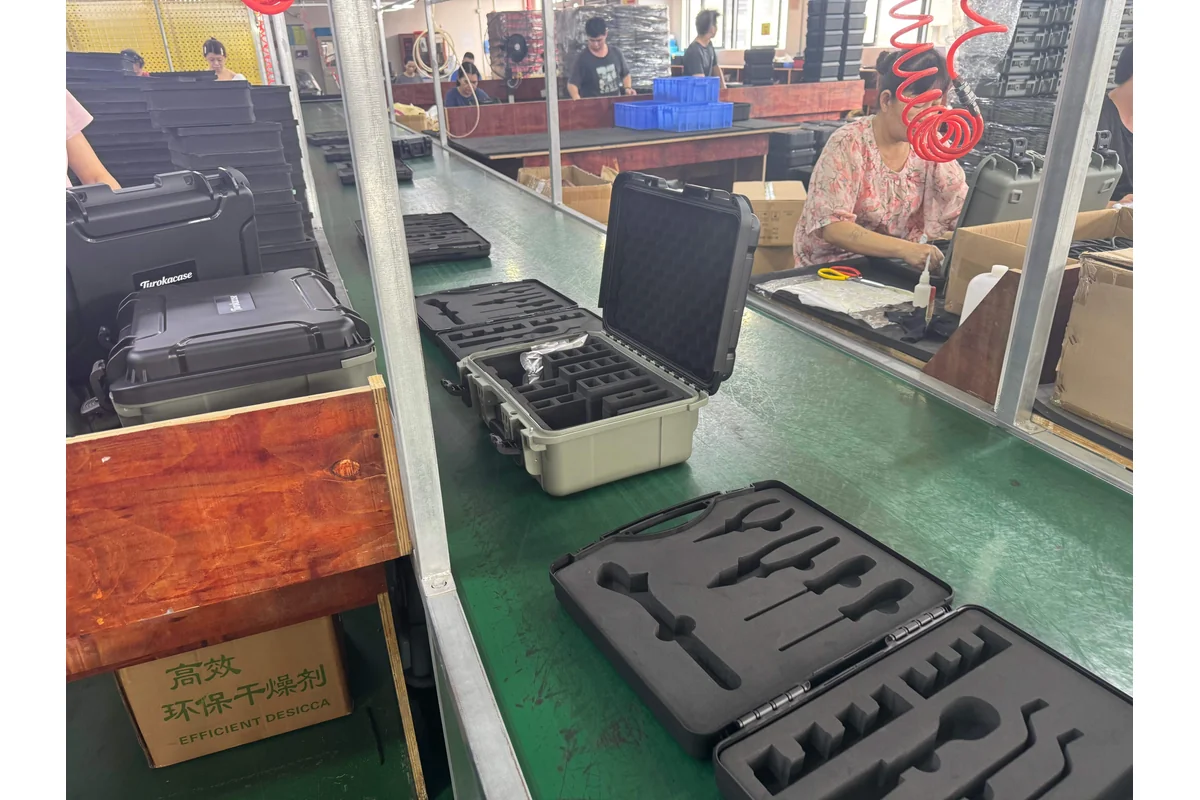
Direct answer: Kexin's custom case engineering follows a 7-step process: Briefing → DFM (Design for Manufacturing) → 3D CAD → T1 Sample → T2/T3 Refinement → Tooling → Mass Production. Lead time 12–16 weeks for new OEM, 4–6 weeks for ODM with standard tooling. Engineering team of 12 (5 senior engineers with 10+ years experience) supports DFM, CAD, prototyping, and tooling. Cost: tooling USD 3,000–10,000 (one-time), per-unit case USD 8–15 depending on size and material. MOQ 500 pieces. Author: Kexin Engineering Team.
Kexin Engineering Team
Kexin New Material (Guangdong) Co., Ltd. has a 12-person engineering team dedicated to OEM/ODM custom case design. The team includes 5 senior engineers with 10+ years of experience in protective case structural design, IP67/IP68 sealing, MIL-STD-810H testing, and foam integration. The lead engineering team for custom projects is the Kexin Engineering Team (12 specialists, 5 senior engineers) with 15+ years of collective experience designing cases for military, medical, and industrial clients.
The engineering team supports all aspects of custom case development:
- DFM (Design for Manufacturing). Material selection, wall thickness, draft angles, rib design, gate location.
- 3D CAD modeling. STEP / IGES / STL / SolidWorks / Fusion 360 / CATIA / UG / Pro-E.
- 2D technical drawings. Dimensioned drawings with tolerances, GD&T, BOM, surface finish.
- Rapid prototyping. SLA / SLS / FDM 3D printing for design verification (1–3 days).
- Tooling design. Aluminium / steel mould design, mould flow analysis, mould life estimation.
- Sample evaluation. T1 / T2 / T3 sample testing per ISO 2859-1, AQL 1.0 / 2.5.
- Process engineering. Injection moulding parameters, secondary operations (printing, assembly, foam).
For new OEM projects, the engineering team is involved from day 1 (briefing) through mass production. We do not subcontract design to third parties — all engineering is in-house at our Guangdong facility.
The 7-Step Custom Case Process
| Step | Activity | Duration | Deliverable |
|---|---|---|---|
| 1 | Briefing & feasibility | 1–3 days | Engineering review, feasibility report, indicative cost |
| 2 | DFM analysis | 3–5 days | DFM report with material, wall thickness, draft, rib recommendations |
| 3 | 3D CAD & technical drawing | 5–10 days | 3D model + 2D drawing + BOM |
| 4 | T1 sample (3D print or soft tooling) | 3–7 days | T1 sample (3D print for design check) + technical sample quote |
| 5 | T2 sample (aluminum tooling) | 4–6 weeks (tooling + sample) | Functional sample in production material |
| 6 | T3 sample (refinement) | 2–3 weeks (if needed) | Final sample with customer-approved specs |
| 7 | Mass production tooling & production | 4–6 weeks (steel tooling) + 30–45 days (production) | Production parts at MOQ 500 |
Total lead time for a new OEM custom case: 12–16 weeks from briefing to first production parts. For ODM with standard tooling (just colour + logo + foam customization): 4–6 weeks. For repeat orders of existing design: 4–6 weeks (tooling already done).
Step 1: Briefing & Feasibility
The briefing is the foundation. We collect:
- Product to be protected. Dimensions, weight, fragility, special handling.
- Use environment. Indoor / outdoor, transport mode, IP rating, MIL-STD requirements.
- Quantity & timeline. Annual volume, MOQ, target launch date.
- Budget. Target per-unit cost, tooling budget cap.
- Branding. Pantone colour, logo type, packaging.
- Compliance. CE / RoHS / REACH / ITAR / MIL-STD / FDA / MDR.
Within 1–3 days of the briefing, we provide a feasibility report covering: case series recommendation (0 / 1 / 6 / 7 / 8 / 9 / Trolley), IP rating, MIL-STD applicability, tooling feasibility, indicative cost (USD 8–25 per case for OEM, USD 0–5 for ODM customization), and lead time. Customer decides whether to proceed to DFM.
Step 2: DFM Analysis
DFM (Design for Manufacturing) is the critical step that determines whether the case can be manufactured cost-effectively at the required quality. Our engineers review:
| DFM aspect | Consideration | Typical recommendation |
|---|---|---|
| Material | PP / ABS / PC / PA / aluminum | PP for general, ABS for rigidity, PC for impact, aluminum for premium |
| Wall thickness | 2–4 mm typical | 2.5 mm for Premium, 3.0 mm for Trolley |
| Draft angle | 1–3° per side | 2° standard, 1° for premium appearance |
| Rib design | Rib thickness ≤ 60 % of wall thickness | 0.6 × wall thickness |
| Corner radius | R 2–5 mm minimum | R 3 mm standard, larger for premium |
| Gate location | Non-visible, balanced flow | Bottom or side, not on top face |
| Hinge / latch | Standard or custom | Standard for ODM, custom for OEM |
| Seal / gasket | Silicone / TPU / EPDM | Silicone for IP67/IP68, TPU for IP65, EPDM for cost-sensitive |
| Undercuts | Avoid if possible | Side-action cores for unavoidable undercuts |
| Surface finish | Smooth, textured, pattern | Textured standard, smooth premium, pattern optional |
DFM analysis takes 3–5 days and produces a report with specific recommendations. This is where we catch 80% of design issues that would otherwise cause tooling rework, mould failure, or field failure.
Step 3: 3D CAD & Technical Drawing
Once DFM is approved, we create 3D CAD model and 2D technical drawing. Format options:
- 3D model: STEP / IGES / STL / SolidWorks (default) / Fusion 360 / CATIA / UG / Pro-E.
- 2D drawing: PDF + DXF (default) / DWG / AI.
- Rendering: Optional 3D renderings (1–2 days) for marketing or pre-sales.
- BOM: Excel / CSV with all components, materials, suppliers, costs.
Lead time 5–10 days for new design. Customer reviews and approves the CAD before tooling. Approval is in writing (email with signed PDF).
Step 4: T1 Sample (3D Print or Soft Tooling)
The T1 sample is the first physical verification of the design. We offer two options:
| Option | Method | Lead time | Cost | Use case |
|---|---|---|---|---|
| 3D print (SLA / SLS / FDM) | Resin or nylon print | 1–3 days | USD 50–200 per print | Design verification, fit check, customer review |
| Soft tooling (aluminum) | Single-cavity aluminum mould | 4–6 weeks | USD 3,000–5,000 | Functional sample, small batch (100–500 pcs) |
For most new OEM projects, we recommend 3D print T1 first (fast, cheap, design check), then aluminum tooling T2 (functional sample, can be used for small batches). 3D prints are not production-grade material (different strength, finish), but they verify fit, dimensions, and aesthetics.
Step 5: T2 Sample (Aluminum Tooling)
The T2 sample is produced in the actual production material (PP / ABS / PC) using aluminum tooling. It is a functional sample suitable for:
- Customer review and final approval
- IP testing (IP54 / IP65 / IP67 / IP68)
- MIL-STD-810H drop and vibration testing
- Customer-side testing (e.g. camera fit, drone fit, instrument fit)
- Small batch production (100–500 pcs for pilot sales or field testing)
Aluminum tooling cost: USD 3,000–5,000 (small cases) to USD 5,000–10,000 (large cases). Tooling life: 10,000–50,000 shots. After 10,000 shots, tooling may show wear and need refurbishment. Lead time 4–6 weeks (tooling fabrication 4–5 weeks + sample 7–10 days within this).
Step 6: T3 Sample (Refinement)
If the T2 sample needs refinement (colour adjustment, foam redesign, latch change, dimension change), we iterate to a T3 sample. Typical reasons for T3:
- Customer wants colour adjustment (Pantone match off)
- Foam cavity needs rework (product fit is too tight or loose)
- Latch force is too high or low
- IP test reveals a sealing issue
- Drop test reveals a structural weakness
- Customer wants to add or change a feature (e.g. handle, label area, vent)
T3 lead time 2–3 weeks. Cost USD 1,000–3,000 (depends on the change scope). T3 is the final sample before mass production tooling.
Step 7: Mass Production Tooling & Production
Once the customer approves T2 or T3, we proceed to mass production. For OEM with new design, we may need steel tooling for higher production volume:
| Tooling type | Cost | Lead time | Tooling life | Best for |
|---|---|---|---|---|
| Aluminum (single cavity) | USD 3,000–10,000 | 4–6 weeks | 10,000–50,000 shots | Small-medium batches, prototypes |
| Steel (single cavity) | USD 8,000–20,000 | 6–10 weeks | 100,000–500,000 shots | Mass production, long lifecycle |
| Steel (multi-cavity) | USD 20,000–50,000 | 10–16 weeks | 500,000+ shots | High volume, fastest cycle time |
For most B2B customers, single-cavity aluminum or steel tooling is sufficient. Multi-cavity is for high-volume OEM (10,000+ pieces per order). Mass production lead time 30–45 days for 1,000–5,000 pieces.
Materials We Work With
| Material | Properties | Cost | Best for |
|---|---|---|---|
| PP (polypropylene) | Light, chemical-resistant, good impact | Low | General purpose, 0/6/7/8/Trolley |
| ABS (acrylonitrile-butadiene-styrene) | Rigid, good finish, paintable | Medium | Standard, premium appearance |
| PC (polycarbonate) | High impact, transparent, premium | High | Premium Premium, transparent windows |
| PA (nylon, polyamide) | Tough, abrasion-resistant, heat-resistant | High | High-stress applications, Trolley |
| Aluminum (6061 / 7075) | Rigid, premium, conductive, heavy | High | Trolley + aluminum frame, EMI shielding |
| PP + glass fiber (10–30 %) | Stiffer than PP, lower thermal expansion | Medium | Mid-Range + Premium reinforcement |
For most B2B cases, PP is the best balance of cost, weight, and durability. ABS for premium appearance. PC for impact-critical. Aluminum for EMI / rugged. PP + glass fiber for reinforcement without cost premium.
Quality Control at Every Step
QC is integrated into the 7-step process, not added at the end:
- Briefing. Customer requirements are documented and verified.
- DFM. Design is reviewed for manufacturability and testability.
- 3D CAD. Dimensions, tolerances, and BOM are checked against the requirement.
- T1 sample. 3D print or soft-tool sample inspected against drawing.
- T2 sample. Functional sample tested for IP, drop, vibration, fit. Customer approval required.
- T3 sample (if needed). Refined sample re-tested.
- Mass production. AQL 1.0 / 2.5 per ISO 2859-1 per lot. Pre-shipment inspection (PSI). Customer or third-party inspector can attend.
For OEM custom cases, we typically have 3–5 inspection points per case. For ODM standard cases, we have 2–3 inspection points. All inspections use calibrated gauges and documented procedures.
Common Engineering Challenges and Solutions
| Challenge | Solution |
|---|---|
| Customer wants IP68 + low cost | Use Premium with IP68 silicone seal; design optimization reduces seal cost by 30 % |
| Customer wants Pantone match on textured surface | Use custom pigment (Pantone-matched masterbatch); texture applied via mould engraving, not paint |
| Customer wants large case (1 m+) for instrument | Steel tooling required; consider 2-piece case design; verify transport cost impact |
| Customer wants anti-static + flame retardant foam | Multi-layer foam: closed-cell PE (anti-static) + PU foam (flame retardant); cost premium USD 2–5 / case |
| Customer has unstable product dimensions | Use pick-and-pluck foam for adjustable fit; recommend OEM design freeze before tooling |
| Customer wants 100,000+ pieces per year | Multi-cavity steel tooling; 16-week lead time; per-piece cost reduced 20–30 % vs single-cavity |
Most engineering challenges are solvable with the right material, design, or process choice. Our engineers are experienced in balancing cost, performance, and lead time to find the optimal solution for each customer.
Author: Kexin Engineering Team
This article is written by Kexin Engineering Team at Kexin New Material (Guangdong) Co., Ltd. the Kexin Engineering Team has 15+ years of experience in protective case design, specialising in IP67/IP68 sealing, MIL-STD-810H environmental testing, and OEM tooling optimization. He has personally engineered 200+ custom case projects for military, medical, and industrial customers across 30+ countries. His expertise includes PP/ABS/PC material selection, foam integration, and design for manufacturing (DFM).
For engineering consultation, contact the Kexin Engineering Team directly at [email protected] or +86 135 9055 5309.
FAQ
How long does a new OEM custom case take?
12–16 weeks from briefing to first production parts. Breakdown: briefing 1–3 days, DFM 3–5 days, CAD 5–10 days, T1 sample 3–7 days, T2 sample 4–6 weeks, T3 (if needed) 2–3 weeks, mass production tooling 4–6 weeks + 30–45 days production.
What is the MOQ for OEM custom cases?
500 pieces for OEM custom cases. 200 pieces for ODM with standard tooling (colour + logo + foam only). 50 pieces for off-the-shelf standard SKUs. 1 piece for samples (USD 100–300 each).
How much does tooling cost?
Aluminum (single cavity): USD 3,000–10,000. Steel (single cavity): USD 8,000–20,000. Steel (multi-cavity): USD 20,000–50,000. Tooling is one-time cost, owned by the customer. Kexin stores tooling free for 24 months.
What file formats do you accept for 3D CAD?
STEP / IGES / STL / SolidWorks (default) / Fusion 360 / CATIA / UG / Pro-E. For 2D drawings: PDF / DXF / DWG. We can also reverse-engineer from physical samples (3D scan, USD 200–500 one-time).
Do you sign NDAs for OEM projects?
Yes. Standard NDA covers drawings, CAD files, tooling specs, and brand information. We sign before sharing any design details or starting OEM tooling. NDA is bilingual (Chinese + English) and legally binding in China.
Can you help with industrial design / styling?
Yes. Our engineering team can propose industrial design (form, colour, finish) based on your product and target market. For complex industrial design (premium consumer products), we partner with external design studios. Cost: USD 2,000–10,000 for industrial design package.
What's the difference between OEM and ODM?
OEM: you design the case, we manufacture. Tooling cost USD 3,000–10,000, lead time 12–16 weeks. ODM: we design (200+ standard toolings), you customize (colour + logo + foam). Tooling cost USD 0, lead time 4–6 weeks. Choose ODM for fast entry; OEM for unique design.
Can I have a virtual factory tour?
Yes. We offer 30-minute virtual factory tour via Zoom / Teams. We show our 6 PP/ABS lines, 2 aluminum CNC, 1 foam CNC, 2 assembly lines, and QC lab. Schedule at [email protected].
What if my product design changes after tooling?
Minor changes (colour, foam): no tooling change, USD 500–2,000 per change. Major changes (dimension, shape): new tooling, USD 3,000–10,000. We recommend design freeze before tooling to avoid costly changes.
Do you provide design services for free?
DFM analysis and 3D CAD are included in the OEM project cost (no separate charge for engineering time on confirmed orders). For customers who only want design without tooling (e.g. for their own manufacturing), engineering is USD 100–200 per hour.
What about intellectual property protection?
NDA signed before sharing design. Tooling ownership certificate transfers mould to customer. We do not use your design for other customers. We do not register your design (you should register in your country). Chinese IP law protects foreign designs if registered with CNIPA.
How do I start an OEM project with Kexin?
Send your inquiry via 4-step RFQ form or email [email protected]. Include: product type, dimensions, IP rating, annual volume, target launch date, target cost. We'll respond within 24 hours with feasibility report and indicative cost.
For more on our engineering process, see our OEM/ODM service page or customer case studies. To start a custom case project, fill out the 4-step RFQ form or email [email protected].